Copart or IAAI: which auction should you choose?
Compare Copart and IAAI by the specific lot: buyer eligibility, documents, fees, transport, and the total cost of bringing a vehicle to Georgia.

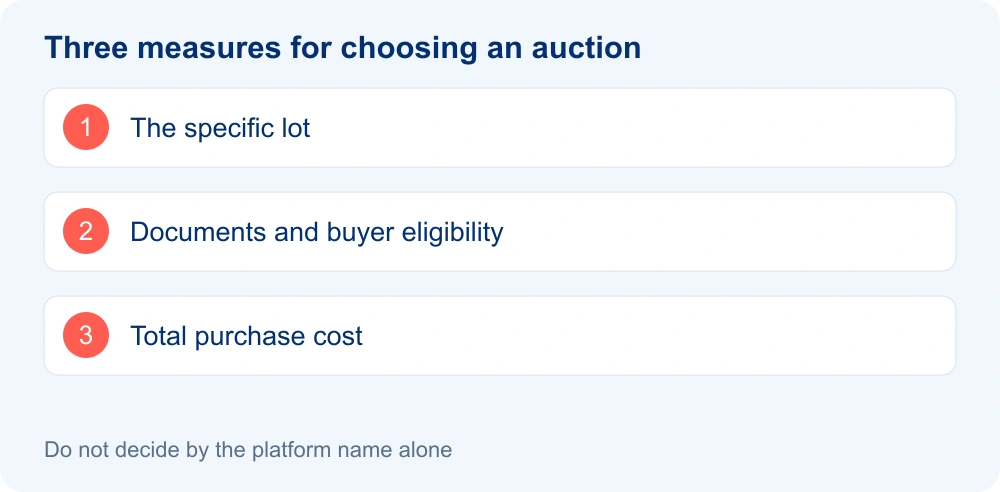
Short answer: Choose between Copart and IAAI by comparing specific lots. Check the document type, who can bid, current auction fees, vehicle location, transport route, VIN data, and total cost in Georgia. Copart's official guide separates membership, licensing or a broker, searching, bidding, payment, and collection. IAAI's rules distinguish buyer access by account and state. You cannot name a winner just from the platform's name. Use the AAS catalog to find suitable lots.
How Copart and IAAI work
Copart's official guide sets out an eight-step buying journey: membership, a deposit or suitable membership level, licensing or a broker, vehicle search, adding vehicles to a watchlist, entering an auction, bidding, and payment or collection. This shows that convenient searching is only the beginning of the process.
IAA's buyer services page covers registration, payment, transport, searching, bidding methods, and vehicle data separately. On the same page, IAA mentions more than 300 data fields on a vehicle page and a cost calculator. Its registration page also says business buyers can participate at more than 200 locations with the appropriate documents. That scale describes an opportunity, not the quality of a particular vehicle.
Which access rules and documents determine your choice?
First check who may bid on the specific lot. Copart says some vehicles require a valid license, while buyers use a broker for other options. Under IAA's official registration rules, public-buyer access depends on the state and lot conditions, while business buyers need valid licensing documents.
The second key issue is the title document and sale status. The same platform may offer a damaged vehicle, a different title status, or a lot that your particular account cannot buy. Start with the lot page rather than the platform's general reputation.
Copart vs IAAI: comparison table
| Criterion | Copart | IAAI |
|---|---|---|
| Access | Some lots require a license or broker | Public and business access varies by lot and state |
| Buying process | Membership, searching, bidding, payment, and collection are covered in one guide | Registration, bidding, payment, and transport are described as separate buyer services |
| Reading the data | Check the lot description, photos, document type, and eligibility | IAA mentions over 300 fields on a vehicle page, but each lot must be read individually |
| Costs | Verify current fees in the lot conditions and your account | The calculator combines the bid, auction costs, and possible transport |
| Delivery to Georgia | Calculate inland transport, port, and sea shipping separately | Confirm the transport quote and final port costs separately |
The table's main value is separating the platform from the lot. Better general statistics for one company do not remove the need to check a specific vehicle's documents, location, and costs.
Also consider information that the two sites label differently. One lot may separately list the presence of keys, an engine-start video, or title status; another may place those fields elsewhere. Similar wording is not enough. Open each record, copy its labels into your comparison, and mark which facts are supported by photos, documents, or only the seller's description. This reduces the risk of treating different information as equivalent.
How to compare two specific lots
For a quick comparison, put both lots on one sheet and complete the same fields:
- Record the lot link, VIN, location, document type, and sale status.
- Note whether you need a broker or special license.
- Check buyer, online, and other current fees directly in your account.
- Add yard-to-port transport, sea shipping, port costs, and registration in Georgia.
- Flag unknown fields and pause the decision until you obtain their sources.
A practical decision rule is to choose the lot with fewer unknowns and clearer documents when vehicle conditions and total costs are comparable. This does not declare Copart or IAAI better overall. It makes the buyer compare both options on the same basis.
How auction choice connects to costs in Georgia
The auction ending is only one stage of importing a vehicle. The Georgian Revenue Service's Auto/Moto Levy Calculator separately calculates customs-related charges from the supplied data. Its result does not replace auction fees or a transport quote.
Check registration documents and current service fees on the Service Agency website. If a Copart lot is in a remote yard and a similar IAAI vehicle is near a port, comparing their winning prices alone is insufficient. Lot location directly affects cost.
What the platform name cannot tell you
Neither Copart nor IAAI can establish that a particular vehicle can be restored safely, that its repair cost is known in advance, or that every defect appears in the photos. Auction status describes sale conditions and available records. Assessing physical condition requires photos, VIN history, documents, and, where necessary, an independent inspector.
Do not use a platform's overall figures as the reason to choose a vehicle. IAA mentions more than 200 locations and Copart an eight-step process. Those numbers describe their operations, not the financial outcome of a particular lot. Base your final choice on written costs and documents.
A five-point decision checklist
- Compare lots with the same type of document.
- Confirm your account or broker is eligible to bid on that lot.
- Save a screenshot or written confirmation of current fees.
- Add transport and Georgian customs or registration costs to both options.
- Choose the option whose decision trail another person can verify.
To prepare the next step for specific lots, use the AAS vehicle request form. Read about total-cost planning in the vehicle import budget guide, document checks in the VIN guide, and physical-condition risks in the Run and Drive article.
This article was prepared with AI assistance; its sources and text were checked through an editorial review process.
Related reading
Next steps
Related articles

The cost of importing a car from the USA to Georgia: a complete budget
Learn how to budget for a car from the USA: auction fees, transportation, customs clearance, registration, and costs that still need confirmation.
Read article
Checking a VIN before buying a car from the USA
Use the VIN to check vehicle identity, title status, mileage, and manufacturer safety recalls. Understand a history report’s limits before buying.
Read article
Car customs clearance in Georgia: what to check before buying
Customs clearance involves three separate checks. Learn how to verify current rules, Revenue Service calculator inputs, and documents before buying.
Read article