Checking a VIN before buying a car from the USA
Use the VIN to check vehicle identity, title status, mileage, and manufacturer safety recalls. Understand a history report’s limits before buying.
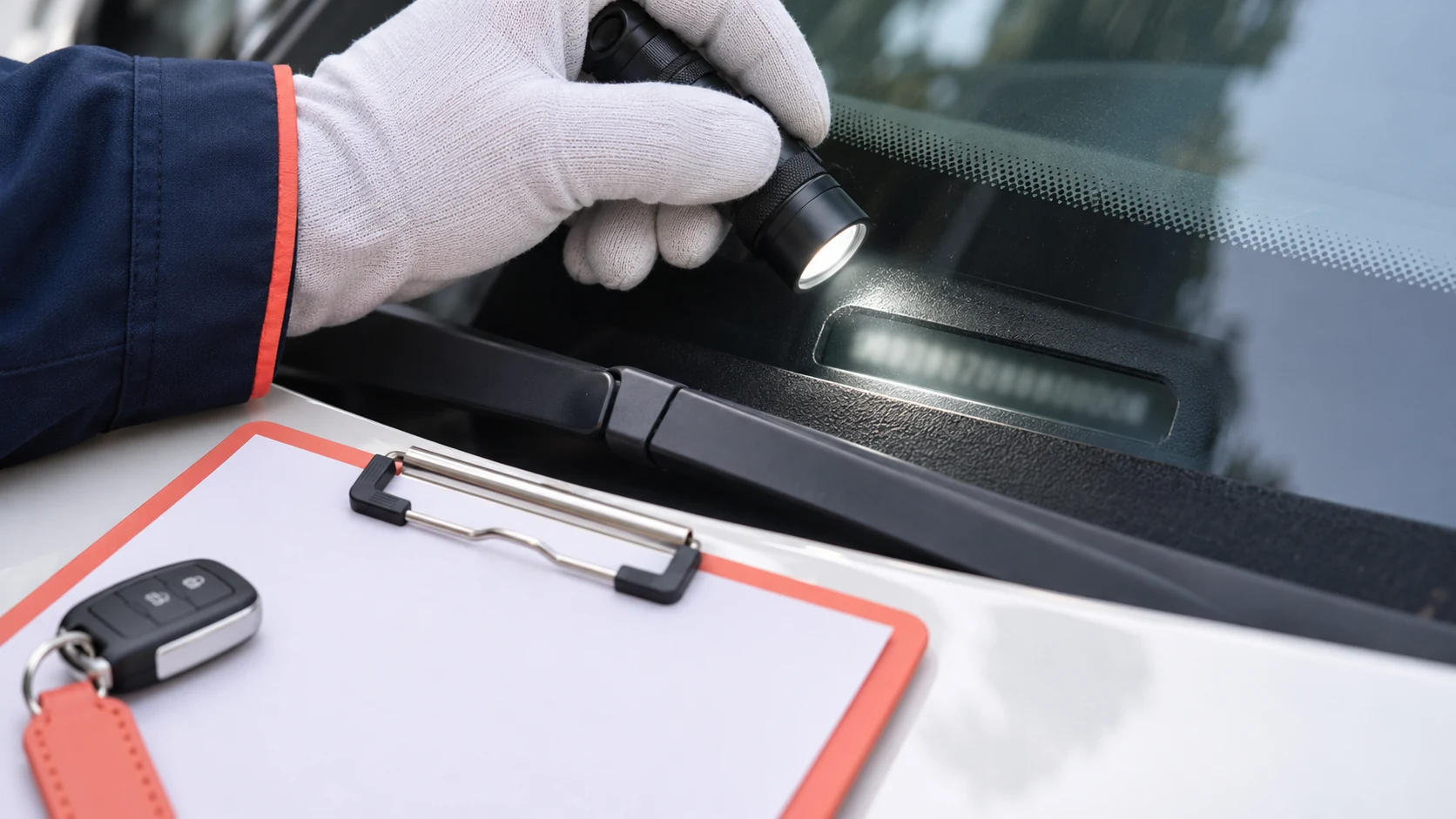
Short answer: Check a VIN against several independent sources. The code identifies a specific vehicle, while a history report may show title status, recorded brands and restrictions, mileage, loss or damage history, and manufacturer safety recalls. A clean report cannot establish physical condition. Before buying, compare the VIN on the body, documents, and lot page, then consult the guidance on AAS's Title Status page.
What a VIN tells you—and what it does not
A VIN is a vehicle's unique identification number. NHTSA, part of the US Department of Transportation, says a vehicle VIN consists of 17 characters containing coded information about that vehicle. The NHTSA VIN decoder displays identification fields supplied by manufacturers, including the production plant and country.
A decoder helps establish whether the code matches the manufacturer's vehicle description. It does not show every accident, repair, flood trace, or how the engine runs today. That is why a VIN check combines history, title status, mileage, and physical inspection from several sources.
Four areas to check by VIN
| Source | Question | Limit of the result |
|---|---|---|
| VIN decoder | Does the code match the manufacturer's vehicle and production data? | Manufacturer data does not replace a physical inspection |
| Title status | Which brands and restrictions are recorded in the documents? | A brand describes the title record, not the quality of current repairs |
| Odometer records | Are the records consistent? | A missing record does not automatically mean a clean history |
| Safety recalls | Has the manufacturer announced a recall affecting this VIN? | One system does not show every manufacturer's or international vehicle's records |
These four checks do not replace each other. Put the results on one sheet and identify the source of each entry. This makes it clear where a fact is confirmed and where another document or an inspector is needed.
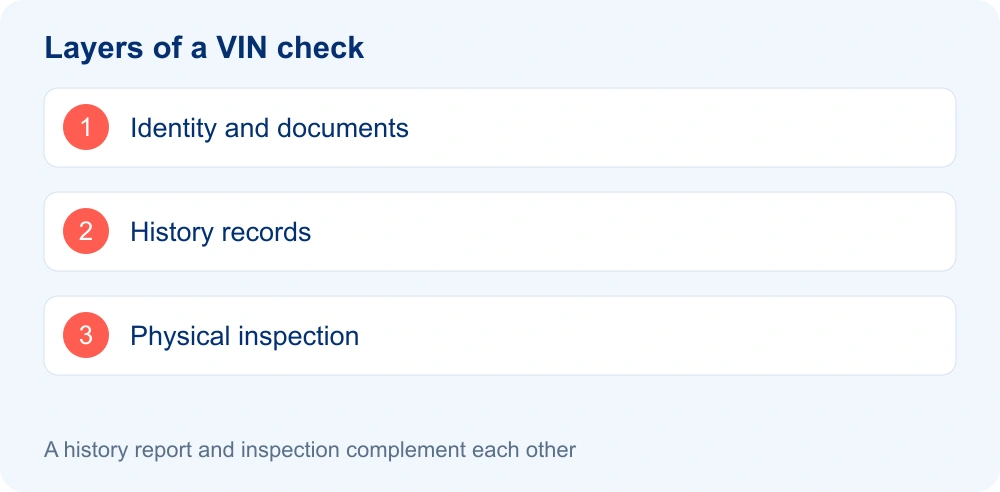
Separating history, title status, mileage, and recalls
The US Department of Justice's NMVTIS guidance says its report focuses on five main indicators: current title information and its latest date, title-brand history, odometer information, total-loss history, and salvage history. A brand may indicate junk, salvage, or flood status. This helps reveal document-related risks, but the record cannot fully describe the vehicle's present condition. See the NMVTIS report explanation.
A clean NMVTIS report means the relevant warning did not appear in that system. It does not prove that the vehicle has never had an accident or that repairs were performed well. The official page itself recommends combining an independent physical inspection, an NMVTIS report, and additional sources.
Check manufacturer safety recalls separately using NHTSA's VIN search. A recall concerns a safety problem identified for a model or VIN. NHTSA explains that completed recalls, some new records, international vehicle recalls, and some recalls older than 15 years may not appear. The result does not confirm service availability or a free repair in Georgia; it is one stage of verification.
How to check a VIN step by step
- Photograph the VIN on the body, at the bottom of the windshield, on the door label, and in the document.
- Compare every entry character by character. One changed letter or number can show another vehicle's history.
- Enter the complete code into NHTSA's decoder and save the manufacturer-supplied result.
- Request an NMVTIS report from an approved provider. The US Department of Justice publishes a list of those providers.
- Check NHTSA recalls and separately review auction photos, document type, and sale status.
Use this practical test: record every version of the VIN in a table and mark matches and differences. If the body, document, or lot record does not agree, pause before spending money on title and history reports. This prevents a correct report from being attached to the wrong vehicle.
What must match before registration in Georgia?
The Georgian Service Agency describes an inspection as a visual comparison of a vehicle's registration data with its documents. The page gives particular attention to the 17-character VIN stamped on the body. Its inspection and expert examination page helps distinguish document verification from physical identification.
For an imported vehicle, documents, owner information, make, model, year, and VIN should form a consistent chain. Check procedures and deadlines on the Service Agency registration page. A history report may help your decision but cannot replace the agency's document and physical checks.
Why a report does not replace a physical inspection
A history report shows past records. It may lack repairs by private workshops, damage hidden in photos, or a recent event. NMVTIS explicitly says its report is intentionally concise and other private sources may hold additional repair, maintenance, and safety information.
A VIN check cannot tell you the cost of replacing a particular part or whether body repairs were done correctly. Those answers require an inspection, a qualified specialist's assessment, and document verification. Auction photos support a decision; they are not a guarantee.
Interpret a clean record cautiously too. Missing information may mean an authority has not yet supplied it or an event exists in another source. Save the report date, lot photos, and a document copy. If the record changes later, you will have a basis for comparing information about the same car.
Decision checklist
- The VIN matches the body, document, and lot record.
- The decoder's manufacturer data matches the lot description.
- You have read NMVTIS title information, brands, odometer, total-loss, and salvage history.
- You have saved NHTSA recall results separately.
- You considered the document results together with a physical inspection.
To continue selecting a car, use the AAS vehicle request form. See the import-cost article for budget variables, the Copart and IAAI comparison for auction selection, and the Run and Drive guide for physical-condition labels.
This article was prepared with AI assistance; its sources and text were checked through an editorial review process.
Related reading
Next steps
Related articles
Copart or IAAI: which auction should you choose?
Compare Copart and IAAI by the specific lot: buyer eligibility, documents, fees, transport, and the total cost of bringing a vehicle to Georgia.
Read article
The cost of importing a car from the USA to Georgia: a complete budget
Learn how to budget for a car from the USA: auction fees, transportation, customs clearance, registration, and costs that still need confirmation.
Read article
Car customs clearance in Georgia: what to check before buying
Customs clearance involves three separate checks. Learn how to verify current rules, Revenue Service calculator inputs, and documents before buying.
Read article