Car customs clearance in Georgia: what to check before buying
Customs clearance involves three separate checks. Learn how to verify current rules, Revenue Service calculator inputs, and documents before buying.

Short answer: Before buying, customs clearance in Georgia calls for three separate checks: whether the particular vehicle may be imported, which charges the Revenue Service's official calculator shows, and what remains for registration. The current Tax Code uses passenger-car age and engine capacity for excise duty, with steering position and engine type relevant in particular cases. An old post is not a sound basis for concluding that a six-year age ban applies. Record accurate data, retain documents, and confirm each stage separately.
The approach: First check eligibility, then the Revenue Service result, and finally registration requirements and documents.
What is car customs clearance?
Customs clearance is the procedure through which a vehicle enters the import regime and the applicable amounts are determined. Before that, establish whether it falls within the passenger-car category, how its age is calculated, and which engine data must be entered.
For a preliminary transport estimate, use the AAS calculator. It plans the journey from the USA to Poti and does not determine customs charges or the final full budget. For customs, open the Revenue Service Auto/Moto Levy Calculator separately. RS states that the service provides information about charges arising during car or motorcycle clearance and requires the fields to be completed correctly. Neither calculator replaces document checks or the separate registration procedure.
Which three questions should you separate before buying?
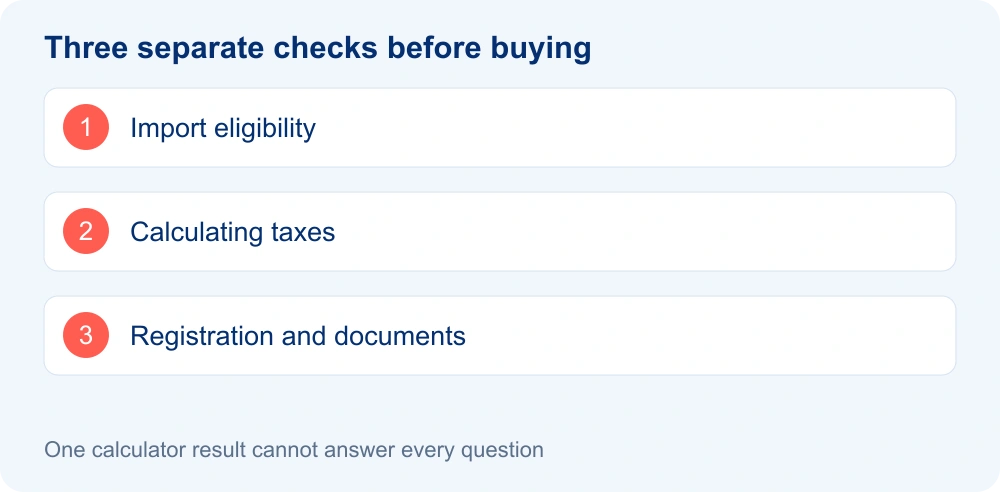
An expensive mistake is treating a tax calculation as permission to import a vehicle. The three-box method reduces this confusion:
| Check | What it answers | What to retain |
|---|---|---|
| Eligibility | Whether this vehicle may be imported under this regime | VIN, title, shipping and ownership documents |
| Tax | Which data the RS calculator uses for charges | Completed fields and the result date |
| Registration | Which services and documents are needed in Georgia | Customs and Service Agency requirements |
If any box remains unclear, pause approval of the maximum purchase bid. An estimate cannot resolve title, VIN, transport, or a representative's power-of-attorney issues.
The three-box method: Mark eligibility, tax, and registration separately. One positive answer cannot replace the other two.
How to check the 2026 rules
Start with the current consolidated Georgian Tax Code. The latest consolidation shown on that page is dated 28 October 2026. The relevant provision groups passenger-car excise duty by age and engine capacity and separately addresses hybrids, electric vehicles, and right-hand-drive cases.
The same text links vehicle age at import to the difference between the customs declaration registration year and the year of manufacture. Do not infer age only from the year in an advertisement. Record VIN data, production year, and declaration timing together.
The transitional provision of the 1 April 2026 amendment sets separate conditions for different transport types. In some cases, evidence of transport starting before 2 April 2026 and the relevant recording before 1 July 2026 is required. This is a document-dependent transitional rule, not a conclusion that importing a vehicle older than six years is automatically prohibited. Assess the particular VIN and paperwork.
The Revenue Service's announcements page also changes. Find the document that directly applies to your category, date, and customs procedure.
How to complete the official calculator and avoid errors
Start with data that can be read accurately from the document:
- Check that you selected a car, not a motorcycle or another category.
- Enter the production year and engine capacity in the units the service requests.
- Specify fuel or engine type and steering position if those fields are available.
- Enter days used only when the relevant extension of the period is documented.
- Save the result that day and attach the source used to complete the fields.
Make a second check after verifying one field. For example, recheck the production year or engine capacity against the document and calculate again. If the result changes, record the reason before relying on it. This simple control helps catch an incorrectly entered year or capacity.
The two-check rule: Save the result once from the document and again after verifying a field. A difference requires an explanation.
How clearance, eligibility, and registration differ
Eligibility asks whether the car can enter Georgia with specific documents under a particular regime. Clearance asks which charges arise on declaration. Registration concerns recording the vehicle in Georgia, its certificate and plates, and Service Agency procedures.
One organization may plan all three stages, but their evidence differs. A calculator does not verify a title's authenticity. Complete paperwork does not mean tax has been paid, and paid tax does not mean all registration requirements are met. Use AAS Title Status to check an auction-document category, and keep shipping documents in a separate folder.
Where an online calculator's limits begin
An online calculator depends on the inputs and current rules. It cannot read a missing or contradictory title, identify an ownership-chain problem, or replace a customs decision. Transitional dates may require a bill of lading, waybill, recording certificate, or other evidence of when transport began.
If documents conflict, do not guess an input. Request a written explanation of which document is accepted as proof. Use the AAS vehicle request form to send the VIN, production year, engine, steering position, and available documents together.
Practical checklist before buying
- The VIN matches the lot in the AAS catalog, title, and shipping document.
- Production year and engine capacity agree across documents.
- Steering position and engine type are established where they affect tax rules.
- The RS result is saved and its inputs explained.
- Tax, registration, transport, and additional services are recorded separately.
- If relying on a transitional rule, you hold evidence of the relevant dates.
If even one item lacks an answer, postpone buying until you obtain the document. That pause is inexpensive compared with the risk of budgeting under the wrong category.
Frequently asked questions
Is importing a six-year-old car automatically banned?
The current Code uses age thresholds in excise categories. A threshold alone is not proof of an automatic import ban for a particular vehicle. Check eligibility and tax separately.
Is the RS calculator result the final amount?
It provides information about clearance charges based on your inputs. For a final assessment, verify documents, regime, deadlines, and registration services with the relevant authorities.
Where should I check registration requirements?
Consult the Service Agency's official page and prepare the VIN, title, shipping, and ownership documents. Use the current official source whenever a requirement changes.
Related reading
- The complete vehicle import budget
- Vehicle transport from the USA to Poti
- How to choose a car import company
This article was prepared with AI assistance; its sources and text were checked through an editorial review process.
Next steps
Related articles

Copart or IAAI: which auction should you choose?
Compare Copart and IAAI by the specific lot: buyer eligibility, documents, fees, transport, and the total cost of bringing a vehicle to Georgia.
Read article
The cost of importing a car from the USA to Georgia: a complete budget
Learn how to budget for a car from the USA: auction fees, transportation, customs clearance, registration, and costs that still need confirmation.
Read article
Checking a VIN before buying a car from the USA
Use the VIN to check vehicle identity, title status, mileage, and manufacturer safety recalls. Understand a history report’s limits before buying.
Read article