Buy Now or auction bidding: how to buy a car
Buy Now offers a quicker decision; bidding puts you in a competitive process. Choose by the lot’s documents, risks, and your written spending limit.

Short answer: Choose Buy Now when the price, documents, and condition are sufficiently checked and securing the deal quickly matters more than waiting. Choose bidding when you are ready for competition and have a maximum limit written in advance. In both cases, assess the title, VIN, damage description, and subsequent costs for Georgia before deciding. Choosing a button cannot replace checking the lot.
The approach: Buy Now offers a fast price decision, bidding offers a competitive opportunity, and either choice must stay within your written limit.
What does Buy Now mean?
Buy Now is a way to purchase a particular lot before an auction or during a separate window at a seller-specified price. Copart's current terms state that Buy It Now allows an immediate purchase of certain vehicles at a price set by the seller before the auction. It is not available for every lot; final conditions depend on the listing and buyer eligibility.
A quick choice is not only about time. Check the title, VIN, lot conditions, sale status, payment rules, collection terms, and the document you will receive. If an answer is missing, use the AAS vehicle request form to set out your questions together before confirming.
How auction bidding works
The buyer sets a maximum amount above which they will not compete for the lot. A platform may increase bids automatically in small steps up to that limit, while other participants compete during a live sale. Copart's terms describe preliminary bids and real-time virtual sales, including cases requiring a seller's minimum or approval.
The highest bid may not become a completed transaction. A listing may have a minimum bid, seller approval, or a counteroffer option. Your maximum must remain a ceiling that the pace of the sale or another bidder cannot pressure you to exceed.
How Buy Now and bidding differ
| Criterion | Buy Now | Auction bidding |
|---|---|---|
| Price format | Seller-specified offer | Bid changes through competition |
| Time | You can attempt a purchase without waiting for the auction | You wait for the bidding window or sale conclusion |
| Main risk | A quick decision may shorten checks | Competition may push you beyond your limit |
| Confirmation | Check when the purchase becomes final | Check whether seller approval is needed |
| Who it suits | A buyer who has already checked the lot | A buyer with a clear ceiling who is ready for competition |
This is not a ranking of platforms. Copart and IAA rules can differ by market, account, and lot. IAA's official Buy Now page describes a fixed-price purchase and a process different from incremental bidding. Use the example to understand the process, then read your own lot's rules separately.
Setting a bid ceiling in a fictional example
In a fictional scenario, Nino wants a specific SUV but first sets the maximum lot purchase amount. That is not the full budget for importing the car to Georgia. She keeps a separate reserve for documents, transport, taxes, and unexpected costs, then sets only the bid ceiling she can afford for the lot itself.
When bidding reaches her limit, Nino leaves the lot even if another participant offers one increment more. With Buy Now, she compares the same written limit with the seller's price and checks that the document and transport reserve remains. The example is invented, but the rule is practical: do not combine the purchase ceiling and the full project's reserve on one line.
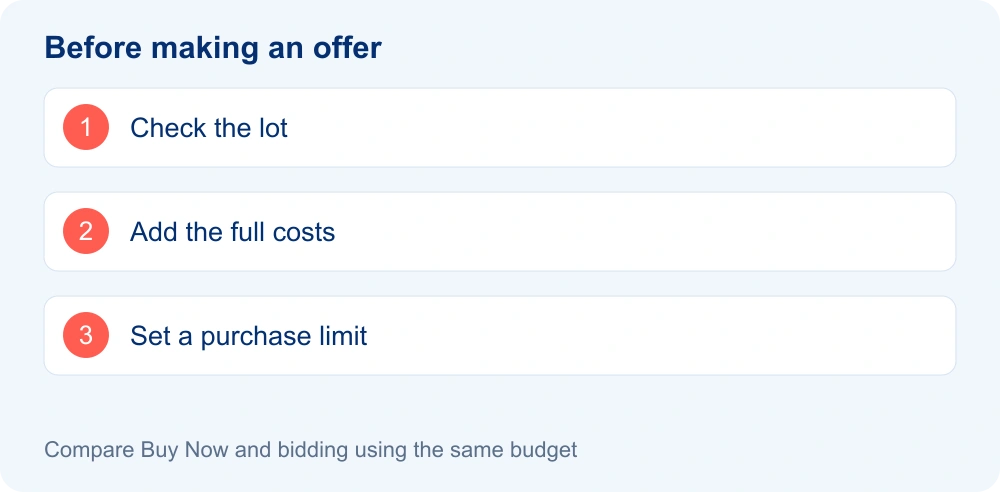
Three layers of a limit: Write down the lot ceiling, a separate reserve for known later costs, and a predetermined exit condition.
Which checks should be finished before bidding?
- Compare the VIN, title, description, and identifier visible in photos.
- Write down known damage and unknowns. Photos are not a complete technical inspection.
- Read the sale type: Buy Now, live auction, timed auction, minimum bid, reserve, or seller approval.
- Check buyer status and licensing. IAA's US registration page notes that Public Buyer access depends on state rules.
- Determine who handles collection, documents, and onward transport.
- Before confirming a bid or Buy Now purchase, record what makes the deal final and whether cancellation is available.
The AAS catalog helps with initial browsing, and the calculator page helps you gather data for subsequent costs. These are decision aids and do not change a particular auction's terms.
Where the buying-method comparison ends
Buy Now and bidding are purchasing methods. They cannot establish suitability for Georgia, the outcome of clearance, arrival condition, or servicing needs. The official RS calculator separately uses vehicle data to provide charge information. Keep the purchase-method choice and tax checks as separate tasks.
Do not compare only the advertised amount. Platform conditions may include buyer fees, collection deadlines, storage rules, counterbids, or account restrictions. Save the specific lot's terms in writing and base your limit on that version.
Stop card: Before bidding, write the lot identifier, maximum amount, and reason you will leave the process on one sheet. Do not rewrite the card during the decision.
How to choose a method
- Choose Buy Now when documents are checked, the price fits your ceiling, and you have a reason to secure the deal quickly.
- Choose bidding when the lot is reliably assessed, you are ready to compete, and your exit rule is written.
- Pause both methods if the title, VIN, account eligibility, or later-cost reserve is unclear.
- If questions accumulate, use the vehicle request form and include the lot, VIN, and preferred method.
Frequently asked questions
Is Buy Now better than bidding?
No. It reduces some waiting and competition, but the price may not fit your ceiling or the document risk. Decide based on checks and a written limit.
Is a maximum bid the full vehicle cost?
It is only the highest amount you intend to offer at auction. Fees, transport, taxes, storage, and registration need separate calculations.
Can a bid be cancelled?
Cancellation depends on the platform and specific operation. Read the conditions before confirming rather than relying on experience with another lot.
Related reading
This article was prepared with AI assistance; its sources and text were checked through an editorial review process.
Next steps
Related articles

Run and Drive and damage: what to check on an auction lot
Run and Drive is a limited check performed at the yard. Learn how to assess damage, airbags, water traces, and vehicle structure before buying.
Read article
How to choose a car import company
Compare written quotes, cost boundaries, payment documents, progress reporting, and vehicle handover terms when choosing an importer.
Read article
Copart or IAAI: which auction should you choose?
Compare Copart and IAAI by the specific lot: buyer eligibility, documents, fees, transport, and the total cost of bringing a vehicle to Georgia.
Read article